
Nadi Parikshan vs. Modern Medical Reports
Ayurvedic pulse diagnosis does not replace modern investigation. It asks a different question. Modern reports often confirm what has already become measurable in tissue or chemistry; Nadi Parikshan listens earlier, reading pattern, tendency, constitution and imbalance before the body has fully declared disease.
The Pulse as a River of Information
In Ayurveda, the pulse is more than rate and rhythm. It is a living expression of how the whole system is functioning: digestion, tissue nourishment, mental strain, metabolic heat, congestion, depletion and recovery capacity. The trained practitioner is not merely counting beats. They are listening for a pattern.
This is why Nadi Parikshan has always been regarded as a subtle art. The body may look outwardly stable while the pulse already shows rising dryness, heat, heaviness or irregularity. In that sense, pulse diagnosis is less about naming a disease and more about identifying the direction in which the system is moving.

The Three Dosha Movements in the Pulse
Classical Ayurveda often teaches pulse-reading through memorable movement patterns. These descriptions are not decorative language; they help the practitioner recognise the quality of each dosha under the fingers.
Vata
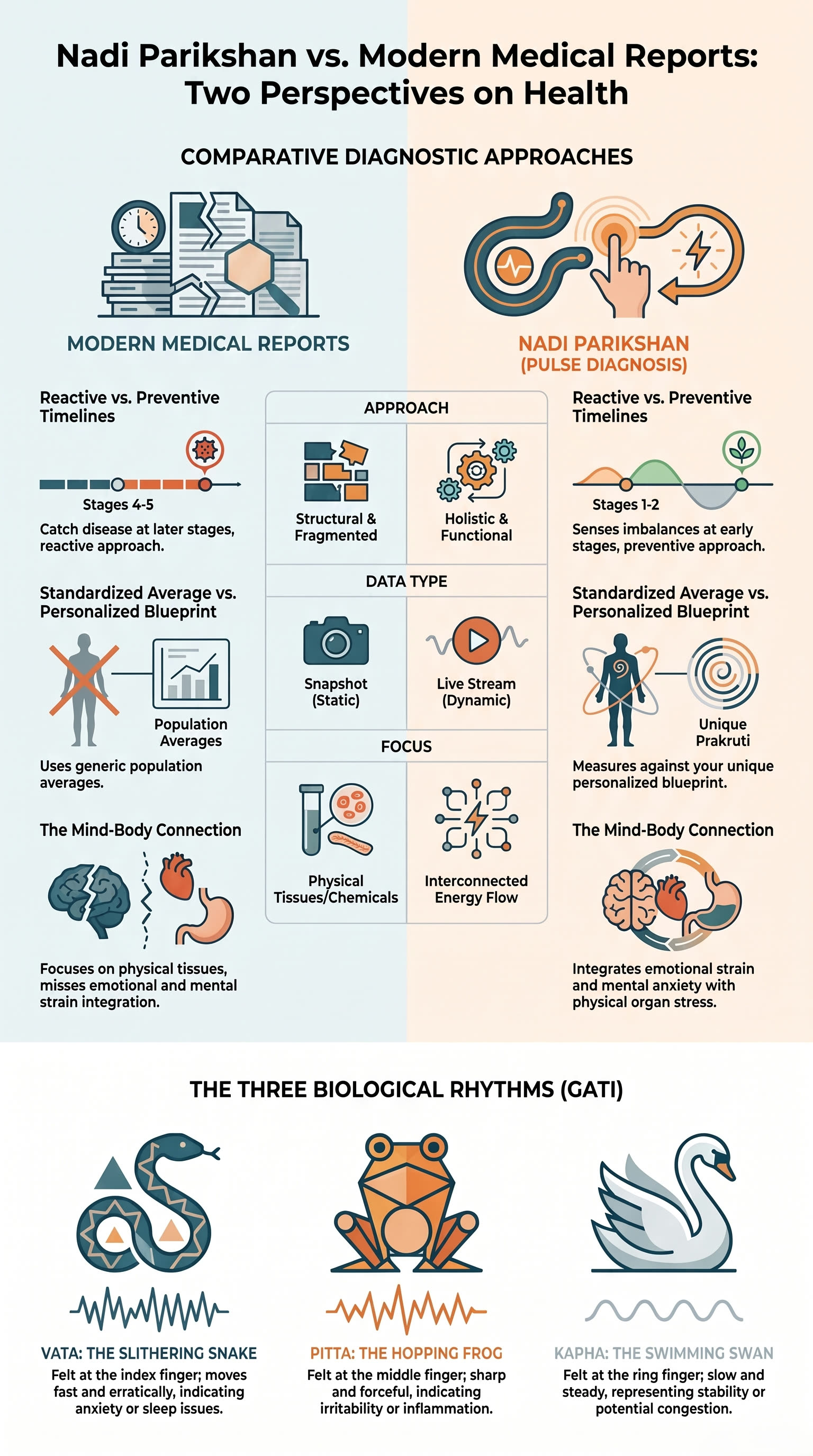
Felt beneath the index finger. Fast, light, irregular and changeable. Traditionally compared to the movement of a snake. When prominent, it may reflect anxiety, dryness, poor sleep, variable appetite or instability in routine.
Pitta
Felt beneath the middle finger. Sharp, warm, active and forceful. Often compared to a frog. When aggravated, it may reflect acidity, irritability, inflammatory tendency, overdrive or intensity in the system.
Kapha
Felt beneath the ring finger. Slow, deep, steady and smooth. Compared to a swan gliding across water. When excessive, it may point to heaviness, congestion, sluggish metabolism or retention.
What Makes Pulse Diagnosis Different
Modern Reports
- Measure tissue, chemistry, structure and visible change
- Compare against standard ranges and population averages
- Excellent for confirmation, staging and tracking measurable pathology
- Usually become most useful once the imbalance is already more developed
Nadi Parikshan
- Reads constitution, imbalance and direction of change
- Measures the patient against their own prakruti, not only a population norm
- Includes digestion, stress response, recovery and mind-body interaction
- Can detect subtle functional disturbance before disease becomes structurally obvious
Why Ayurveda Calls It Preventive
One of the great strengths of Nadi Parikshan is that it aims to sense imbalance early. A patient may not yet have a dramatic lab abnormality, yet the pulse may already show excess heat, weak digestion, poor tissue nourishment or unstable nervous system rhythm. From an Ayurvedic perspective, waiting for the final stage is not ideal. Correction should begin while the pattern is still reversible.
This is one reason pulse diagnosis remains so relevant today. Many people are not completely unwell, but they are not well either. They live in the middle zone: disturbed sleep, acidity, bloating, stress, fatigue, recurrent headache, irritability or heaviness. Pulse diagnosis helps make sense of that stage.
Prakruti, Vikruti and the Personal Blueprint
Modern reports tell us whether a marker falls within range. Ayurveda asks something more individual first: What is this person's natural constitution? Nadi Parikshan helps distinguish between prakruti (the original constitutional blueprint) and vikruti (the present imbalance). This matters because the same symptom may arise from very different internal patterns in different people.
Two people may both complain of acidity, but one may be driven by pitta heat and irritability, while another has vata irregularity disturbing digestion from the nervous system side. The pulse helps separate those stories.
Mind and Body Are Not Separate in the Pulse
Ayurveda does not divide emotional strain from physical function as sharply as modern medicine often does. Stress, grief, restlessness, suppressed anger and exhaustion affect appetite, sleep, elimination, muscular tension and tissue quality. The pulse reflects that integration. It does not treat digestion, emotion and recovery as unrelated compartments.
This is why Nadi Parikshan is often deeply meaningful for patients whose reports are technically acceptable yet who still feel unwell. The pulse may show the burden of long-standing overwork, irregular routine, disturbed sleep or internal overstimulation.
The Quiet Skill Behind the Reading
Pulse diagnosis is not mechanical. It depends on sensitivity, training and a quiet observing mind. Classical teachers describe the practitioner entering a still, attentive state before reading. The pulse reveals more when the observer is not forcing interpretation.
That is also why authentic Nadi Parikshan should not be reduced to a novelty or a quick dramatic claim. Its value lies in disciplined observation and correct application within a broader Ayurvedic assessment.
Where This Fits in Real Clinical Care
At Sattva, Nadi Parikshan supports the larger assessment of digestion, metabolism, dosha balance, lifestyle load and readiness for treatment. It helps guide whether the next step should be dietary correction, daily-rhythm correction, Panchkarma planning, a calming therapy, or further investigation.
Used properly, it gives context. Used alongside modern reports when needed, it helps create a more complete picture of health rather than a narrower one.
Reference: Dr. Vasant Lad, Secrets of the Pulse: The Ancient Art of Ayurvedic Pulse Diagnosis, The Ayurvedic Press, 1996.